When most people imagine a secure data center, they picture a locked server room. The reality is far more demanding. According to IBM’s latest Cost of a Data Breach report, the average cost of a data breach globally was $4.44 million in 2025. For healthcare organizations operating under HIPAA, the stakes climb even higher; the United States led all countries with an average breach cost of $10.22 million in 2025, up from $9.36 million the year before, driven largely by higher regulatory fines.
Understanding what data center security is and how much of it is rooted in the physical world is the starting point for every organization that stores, processes, or manages sensitive data. A single unlocked cabinet, a tailgating visitor, or a facility built without seismic hardening can unravel years of cybersecurity investment in minutes. This data center security guide walks through the layers, compliance requirements, and practical decisions that distinguish a genuinely secure facility from one that merely looks the part.
Key Takeaways
- Physical security is a compliance requirement, not just a best practice: Data center physical security is a compliance requirement for SOC 2, ISO 27001, PCI DSS, and HIPAA certifications; failing these controls can invalidate your audit entirely.
- The cost of inaction is enormous: The IBM Cost of a Data Breach Report 2025 found that the global average breach cost was $4.44 million, but breaches lasting more than 200 days averaged $5.01 million, meaning early detection, driven by physical monitoring protocols, saves real money.
- Insider threats are the dominant risk category: Data centers face a persistent threat from within, with insider threats accounting for 55% of all security breaches. These internal dangers are commonly divided into accidental errors and intentional acts of misconduct. Therefore, access control policies must apply the same scrutiny to employees and contractors as to external visitors.
- A locked door is the floor, not the ceiling: Modern data center security works in depth, so a single front-door checkpoint is a single point of failure, not a security posture.
- California adds a seismic dimension: Organizations choosing a California colocation data center must verify seismic hardening in addition to standard compliance certifications. An earthquake that topples unanchored server racks is a physical security failure with major compliance consequences.
Quick-Start Prioritization Framework
| Security Layer | Best For | Effort Level | Time to Results |
|---|---|---|---|
| Perimeter fencing + CCTV | All facilities | Low | Days |
| Biometric multi-factor access | Any regulated workload | Medium | Weeks |
| Mantrap/airlock entry | Healthcare, financial, government | Medium | Weeks |
| 24/7 SOC monitoring | Enterprise or compliance-driven orgs | High | 1-2 months |
| Environmental controls (fire, flood, power) | All facilities | High | 1-3 months |
| Seismic hardening | California or high-seismic-zone facilities | High | Months |
| SOC 2 / HIPAA audit readiness | Any org handling sensitive data | High | 3-6 months |
Start here if you’re:
- A small or mid-sized team: Begin with perimeter controls and biometric access. These deliver the fastest compliance ROI and meet the baseline physical safeguards required by both HIPAA and SOC 2.
- A healthcare organization: Prioritize HIPAA compliant data center selection first, then verify mantrap entries, visitor logs, and a signed Business Associate Agreement (BAA), these are non-negotiable audit items.
- Evaluating California colocation: Ask about seismic design certification before reviewing any other specs. A facility that cannot survive a major seismic event cannot guarantee uptime or data integrity regardless of its other controls.
What “Layered” Physical Security Actually Means
The phrase “layered security” gets used loosely, but in the context of a serious data center security guide, it has a precise meaning. Layered physical security means securing a data center with multiple, overlapping defenses, much like the rings of an onion. If one layer is breached, the next stands ready, and this defense-in-depth model deters, detects, delays, and ultimately denies unauthorized access to critical systems.
A properly layered approach starts at the perimeter, with fencing, intrusion detection, and vehicle access management, then extends to building access control, identity verification, restricted zones, server halls, power systems, network rooms, and rack-level monitoring for high-value equipment. The value of this model is straightforward: if one control is bypassed or fails, additional safeguards remain in place.
Layer 1: Perimeter Protection
While many people start at the organization’s front door when protecting internal data, the perimeter itself must come first. Start at the property’s edge, with a security detail monitoring the entrance to ensure only authorized people are on the premises. This includes high fencing, motion-activated lighting, vehicle barriers, and AI-assisted outdoor cameras. All vehicles, vendors, contractors, employees, and visitors entering the campus should pass through controlled access points where authorization is verified.
Layer 2: Building Entry and Mantraps
Once inside the fence line, a second authentication layer takes over. Inside the perimeter, main entrances, loading docks, and reception areas require controlled access points where identity is verified before entry is granted. Security doors, mantraps, and turnstiles, often with two-step verification, ensure only authorized personnel gain entry to the facility.
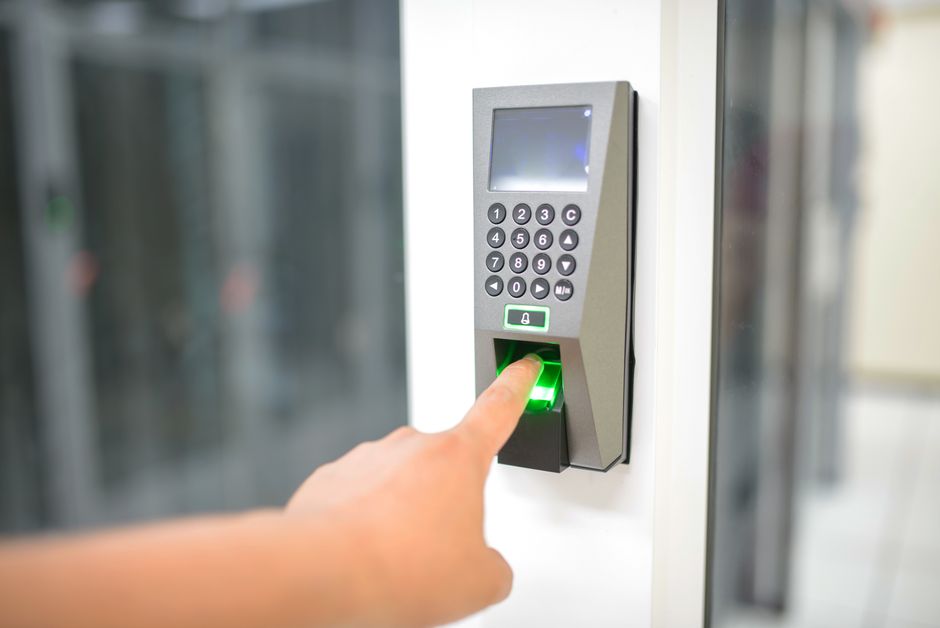
Mantraps (sometimes called airlocks or portals) are enclosed entry chambers that require a first credential to enter and a second credential, often biometric, to exit into the secure zone. Facilities should support multi-factor authentication such as badge plus biometric or PIN, mantrap entries, and documented procedures for managing access lists, and be able to demonstrate who accessed what areas and when.
Layer 3: Internal Zones and Rack-Level Controls
A properly layered approach starts with evaluating security systems. Video surveillance, access control, intrusion detection, and communications tools may be deployed separately, managed by different teams, or reviewed through different interfaces. That fragmentation is a vulnerability. Best-practice facilities divide internal space into zones with discrete access permissions, so a visitor cleared for the loading dock cannot walk into a server hall. Individual server cages can require separate key or biometric access entirely.
Pro Tip: In my experience, the most common physical security gap in colocation environments is stale access permissions. Establish a quarterly access review process where every badge holder’s continued need for access is actively confirmed, not just assumed.
How Physical Security Supports HIPAA and SOC 2 Compliance
This is where physical security stops being a facilities matter and becomes a compliance matter. A HIPAA-compliant data center is not a facility with a special HIPAA certification, because HIPAA does not certify data centers. Instead, a data center supports HIPAA compliance by providing a physical environment, operational controls, and supporting services that help regulated organizations meet the Security Rule’s requirements for protecting ePHI.
The HIPAA Security Rule contains administrative, physical, and technical safeguards that stipulate the mechanisms and procedures required to ensure the integrity of Protected Health Information. The Administrative Safeguards primarily concern ongoing risk assessments to identify vulnerabilities, while the Physical Safeguards concentrate on measures to prevent unauthorized access and protect data from fire and environmental hazards.
HIPAA Physical Safeguard Requirements
Data centers that store or handle ePHI usually operate as business associates under HIPAA, which makes them directly responsible for meeting physical safeguard requirements defined in a HIPAA Business Associate Agreement. This agreement defines the protection requirements for facilities, infrastructure, and systems that store or process sensitive healthcare data.
In practice, this means any HIPAA-compliant data center must provide documented evidence of physical access logs, visitor escort procedures, environmental controls, and a clear separation of responsibilities between the facility operator and the healthcare customer. Retain HIPAA-required documentation for at least six years from creation or last effective date, and align log retention and backup policies accordingly. If you cannot produce those logs at the time of the audit, the certification effort fails regardless of how good your firewalls are.
SOC 2 Physical Security Controls
SOC 2 Common Criteria for Physical Access require documented access control to all areas where systems are housed, visitor escort requirements, documented monitoring of physical access, and environmental controls. SOC 2 auditors evaluate whether physical security controls are designed and operating effectively, not just documented.
That distinction matters enormously. If your security controls only exist on a signed piece of paper, a live audit session will expose the cracks instantly. A data center compliance audit under SOC 2 will include walk-throughs, log reviews, and tests to verify that the stated controls function as described.
Pro Tip: When evaluating colocation providers for regulated workloads, ask for their most recent SOC 2 Type II report, not just a Type I. A Type II report covers operating effectiveness over a period of time, while a Type I only attests to design. The difference is significant for ongoing compliance posture.
The Insider Threat Problem Nobody Talks About Enough
External perimeter threats get most of the attention, but the data tells a different story. Over 70% of security professionals consider their facilities highly vulnerable to physical tailgating breaches, and insider threats are increasing rapidly, with 74% of organizations reporting more frequent internal attacks. Therefore, any honest data center security audit must evaluate internal controls as rigorously as external ones.
Tailgating, where an unauthorized person follows an authorized person through a secured door, is the simplest and most common physical intrusion method. It requires no hacking, no hardware, and no sophisticated planning. Simulating intrusions, tailgating scenarios, and social engineering are how organizations expose gaps before real attackers do.
The Role of Access Reviews and Background Checks
Monitoring for insider threats through background checks and access pattern analysis is a key step in robust physical security for data centers. In practice, this means running background checks before granting any physical access, logging every entry and exit against individual credentials, and flagging anomalous access patterns, such as a technician accessing a zone outside their job function at 3 a.m.
Organizations that treat physical access logs as a passive compliance checkbox rather than an active monitoring tool are the most exposed to insider risk. Log data is only valuable if someone reviews it.
Pro Tip: Role-based physical access should mirror role-based logical access. If an employee’s job function does not require access to a specific server cage or power distribution area, their badge should not open those doors, even if they are senior staff. Least-privilege applies to buildings, not just software.
California Colocation: The Seismic Dimension
For organizations choosing a California data center, whether in the Sacramento area, Silicon Valley, Los Angeles, or San Diego, seismic resilience is a physical security requirement that sits alongside HIPAA and SOC 2, not beneath them.
Data centers are classified as Risk Category IV essential facilities under IBC 2024, which triggers an importance factor requiring every piece of anchored equipment to resist 50% more seismic force than the same equipment in a standard commercial building. The consequences of unanchored equipment failing during an earthquake are severe: server racks toppling can destroy millions of dollars in hardware, sever fiber connections, and create life-safety hazards for personnel.
For California healthcare organizations specifically, seismic compliance extends to your data center operations, whether you host a HIPAA-compliant database, a HIPAA-compliant website, or something else. Hospitals in California must go beyond safeguarding ePHI and address physical site resilience as well.
What to Ask a California Colocation Provider
When evaluating a California colocation data center, ask four specific questions:
- What seismic design standard governs the building structure?
- Are server racks anchored and certified under California Title 24?
- Has the facility been tested or assessed against a credible seismic event scenario?
- Does the provider carry documentation from a licensed structural engineer for all nonstructural components?
Builders of resilient California data centers construct facilities to withstand natural disasters such as earthquakes, using architectural designs and building materials that comply with California’s Title 24 building standards and seismic code provisions intended to limit earthquake risk.
Sacramento-area facilities, including those in Rancho Cordova, sit in a comparatively stable seismic zone relative to coastal Bay Area or Los Angeles sites. Sacramento’s relatively favorable natural hazard profile attracts data center operators. Major operators describe Sacramento as a seismically stable alternative to more fault-active Bay Area locations.
Running a Physical Security Audit on Your Data Center
Whether you manage your own infrastructure or colocate with a provider, a structured data center compliance audit of physical controls should happen at least annually, and immediately after any significant personnel change, facility modification, or regulatory update.
Routinely conducting audits and penetration testing plays an essential role in identifying weaknesses and facilitating the ongoing enhancement of security protocols. Organizations must conduct regular security reviews and implement staff training initiatives to maintain a secure environment.
A practical physical security audit covers these categories:
- Perimeter integrity: Are fences, gates, vehicle barriers, and outdoor cameras fully functional with no blind spots?
- Access credential hygiene: Have all former employee and contractor badges been deactivated within 24 hours of departure?
- Visitor log completeness: Are all entries and exits timestamped and associated with named individuals and a stated business purpose?
- Environmental monitoring: Are temperature, humidity, water leak, and fire suppression systems actively monitored and recently tested?
- Camera coverage: Do cameras cover all entry and exit points with no gaps, and is footage retained for the period required by your compliance framework?
- Incident documentation: Is there a written record of every physical security event, including false alarms?
Risk reduction in data centers spans five core domains: physical security, network controls, monitoring and reporting, personnel practices, and disaster preparedness. A physical security audit that focuses solely on locks and cameras misses the personnel and disaster-preparedness dimensions entirely.

For organizations choosing to colocate rather than operate their own facility, the audit obligation does not disappear; it is partially transferred. Colocation facilities are equipped with advanced physical security, environmental controls, and redundant systems that often exceed the capabilities of in-house server rooms. For small businesses, these features address key compliance requirements including HIPAA’s stringent physical access controls, typically including biometric access controls, 24/7 video surveillance, and manned security.
Datacate’s Rancho Cordova facility is one example of a California colocation provider purpose-built with compliance-driven physical security in mind. It provides multiple layers of protection, including 24/7 on-site security personnel, biometric access controls, mantrap systems, and continuous video surveillance with event-driven alerting. HIPAA, SOC 2 Type II, SOC 3, and CSA STAR compliance ensure a secure, compliant environment for all data and service types. For healthcare organizations in California specifically, that combination of physical controls and audit-backed certifications significantly reduces the compliance burden.
Pro Tip: Before signing any colocation contract, request a physical facility tour, in person if possible. A provider confident in their physical security will welcome it. One that hedges or delays should raise an immediate flag.
Frequently Asked Questions
What is data center physical security, and what does it include?
Physical security in data centers refers to the combination of technologies, personnel, and physical barriers that protect servers and other critical hardware from unauthorized access, tampering, or damage. It is an essential part of a broader security plan that works alongside cybersecurity to protect an organization’s infrastructure from both physical and digital threats. In practice, it covers perimeter fencing, biometric access control, mantraps, 24/7 surveillance, environmental monitoring, fire suppression, and seismic hardening.
How does physical security support HIPAA compliance?
HHS defines physical safeguards as the physical measures, policies, and procedures used to protect systems, buildings, and equipment from natural and environmental hazards and unauthorized intrusion. For a HIPAA-compliant data center, this translates into documented access logs, visitor escort protocols, environmental controls, and a signed Business Associate Agreement with the facility operator. Compliance is not a one-time certificate but an ongoing program that pairs robust controls with evidence, monitoring, and continual improvement.
What happens if a data center fails a SOC 2 physical security audit?
The rigorous SOC 2 compliance requirements are tested during on-site audits, ensuring that organizations are adhering to the necessary controls to safeguard information. If physical security controls are found to be absent, undocumented, or non-operational, the auditor will issue a qualified opinion or identify exceptions in the report, which can trigger downstream consequences for every customer relying on that facility’s compliance posture. For healthcare or financial services customers, a failed SOC 2 audit at their colocation provider can jeopardize their own regulatory standing.
Why does seismic safety matter for California data centers?
Facilities in high-seismic-risk categories must follow strict design and safety measures to remain operational during intense seismic activity. Facilities in Zone 4 regions, such as California, incorporate specialized structural designs and safety systems to ensure stability during earthquakes. A seismic event that causes hardware damage, network disconnection, or extended downtime is a physical security failure with direct HIPAA and business continuity implications.
How do I evaluate a colocation provider’s physical security before signing a contract?
Start by requesting their most recent SOC 2 Type II report and reviewing the physical access control section specifically. Ask for a facility tour, review visitor log procedures, confirm biometric access is in place for server areas, and ask whether their audit scope covers seismic resilience. Evaluate security operations including 24/7 monitoring, incident response maturity, change control, and transparency in reporting, then verify certifications by confirming SOC 2 Type II compliance and ISO 27001 certification scope and recency.
Sources
- IBM Cost of a Data Breach Report 2025, IBM / Ponemon Institute. Global breach cost analysis across 600 organizations. https://www.ibm.com/reports/data-breach
- Average Cost of Data Breaches, United States 2025, Morgan Lewis / Ponemon Institute. U.S. breach cost trends and regulatory fines. https://www.morganlewis.com/blogs/sourcingatmorganlewis/2026/04/study-finds-average-cost-of-data-breaches-decreased-globally-in-2025
- Data Center Physical Security Guide, Alcatraz AI. Insider threats, tailgating vulnerabilities, and biometric trends. https://www.alcatraz.ai/blog/data-center-physical-security-guide
- Data Center Physical Security: SOC 2, ISO 27001 & Technology Architecture, Drone Strategic Partners. Framework-specific physical security requirements. https://www.dronestrategicpartners.com/post/data-center-physical-security-compliance-requirements-and-technology-architecture
- HIPAA Compliant Data Center: What It Is, Key Requirements, and How to Choose a Provider, AccountableHQ. HIPAA BAA and physical safeguard requirements. https://www.accountablehq.com/post/hipaa-compliant-data-center-what-it-is-key-requirements-and-how-to-choose-a-provider
- How Does Physical Security in Data Centers Support HIPAA Compliance?, Atlantic.net. ePHI physical safeguard obligations for business associates. https://www.atlantic.net/hipaa-compliant-hosting/data-center-physical-security-hipaa-compliance/
- HIPAA Compliant Data Center, HIPAA Vault. HHS definitions of physical safeguards and ongoing compliance obligations. https://www.hipaavault.com/resources/hipaa-compliant-data-center/
- Data Center HIPAA Compliance: Requirements, Security Controls, and Audit Checklist, AccountableHQ. Six-year documentation retention and access governance requirements. https://www.accountablehq.com/post/data-center-hipaa-compliance-requirements-security-controls-and-audit-checklist
- SOC 2 Data Centers: A Guide to SOC Data Center Compliance, Linford & Company. SOC 2 audit scope for physical and distributed environments. https://linfordco.com/blog/soc-data-center/
- Layered Physical Security Design for Data Centers, Network Cabling Services. Defense-in-depth architecture explained. Layered physical security means
- Data Center Seismic Anchorage Requirements, Palisade Engineering. ASCE 7-22 seismic anchorage and Risk Category IV requirements. https://www.pe-se.com/blog/data-center-seismic-anchorage-requirements
- California Data Centers: Colocation in the Golden State, Brightlio. Seismic design and Sacramento facility comparisons. https://brightlio.com/california-data-centers-brightlios-ultimate-guide-to-colocation-in-the-golden-state/
- Datacate Facility, Rancho Cordova, CA, Datacate, Inc. Biometric access, mantraps, SOC 2 Type II, HIPAA, and CSA STAR compliance at the Rancho Cordova facility. https://www.datacate.net/gcdc-facility/
- Compliance in the Data Center, Datacate, Inc. How colocation supports HIPAA, SOC 2, and physical security compliance for small businesses. https://www.datacate.net/compliance-in-the-data-center-meeting-regulatory-standards/
- Data Center Threats: Physical and Cyber Risks, ENCOR Advisors. Insider threat statistics and mitigation strategies. https://encoradvisors.com/data-center-threats/
- Data Centers Integrate Cyber and Physical Security in 2025, Data Center Knowledge. Risk domains and AI-integrated security trends. https://www.datacenterknowledge.com/security-and-risk-management/data-centers-integrate-cyber-and-physical-security-in-2025