When most executives in healthcare, finance, or legal services hear the words “SOC 2” or “HIPAA,” their minds immediately go to the digital realm. They think of firewalls, 256-bit encryption, multi-factor authentication, and complex password policies. They envision a perimeter made of code.
However, compliance is not a purely ethereal concept. It has a physical weight. It involves brick, mortar, steel, and glass. In the race to secure data against hackers in distant lands, many organizations overlook the “Physical Safeguards” required by federal law and international standards. This oversight often leads to a hidden burden: a massive operational and financial drain that surfaces only when an auditor asks the dreaded question: “Who has the physical keys to the server room, and can you prove they were the only ones who entered last Tuesday at 3:00 PM?”
At Datacate, we understand that for a growing business, managing the physical infrastructure of a compliant environment is a full-time job that distracts from your core mission. Understanding this burden is the first step toward strategically offloading it.
The Physical Reality of HIPAA and SOC 2
To understand why physical compliance is so taxing, we must examine what regulators actually require.
HIPAA’s Physical Safeguards (45 CFR § 164.310)
Under HIPAA, “Physical Safeguards” are physical measures, policies, and procedures to protect a covered entity’s electronic information systems and related equipment from natural and environmental hazards, and unauthorized intrusion. It isn’t enough to have a locked door. You must have:
- Facility Access Controls: Procedures to allow only authorized personnel access to the areas where servers reside.
- Workstation Use and Security: Policies on screen positioning and hardware security.
- Device and Media Controls: Strict protocols for moving, disposing of, and reusing hardware.
SOC 2 Trust Services Criteria
SOC 2, specifically within the Common Criteria (CC) 6.0 series, focuses on “Logical and Physical Access Controls.” While HIPAA is a legal requirement for healthcare, SOC 2 is the gold standard for service organizations in finance and legal sectors. It requires that “The entity restricts physical access to facilities, data centers, and sensitive areas to authorized personnel to prevent unauthorized access, damage, or interference.”
The challenge isn’t just doing these things; it’s proving you did them.
The Burden of the Audit Trail
The word “compliance” is often used interchangeably with “security,” but the two are distinct. Security is the act of protecting the data. Compliance is the act of proving that the data is protected.
The physical audit trail is where most small- to mid-sized firms stumble. To maintain a compliant environment on-premises, a company must manage:
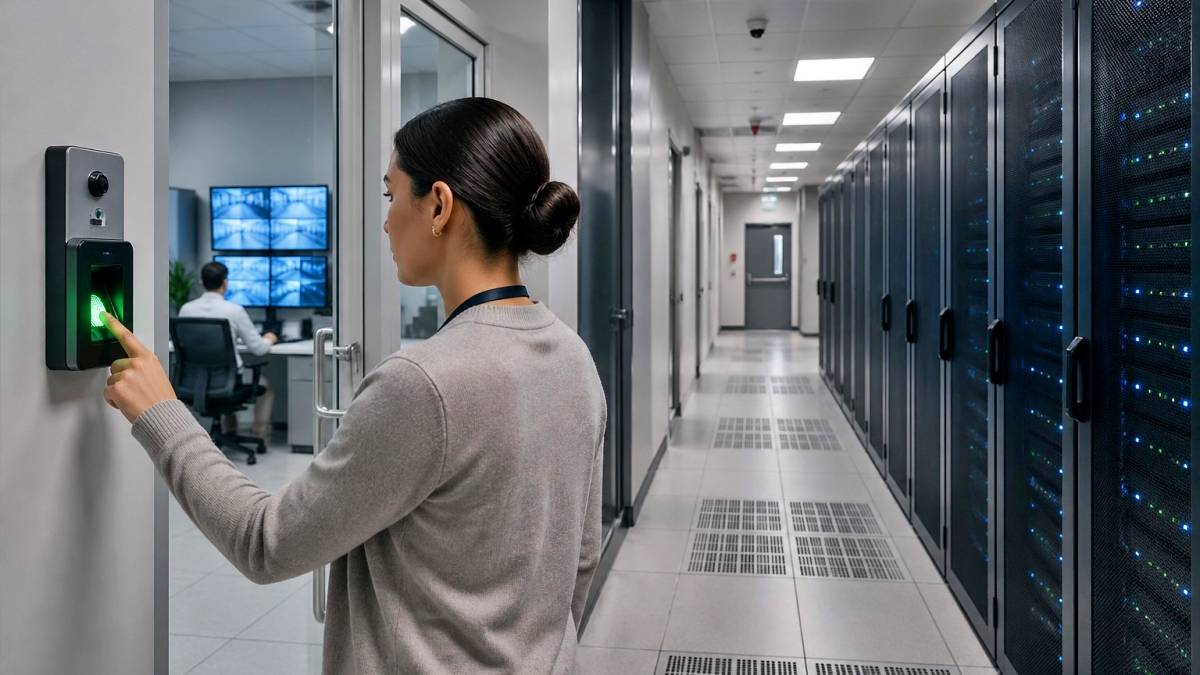
- Access Logs: You need a system that logs every entry and exit. Traditional keys won’t work because they don’t create a digital timestamp or identity verification. You need badge readers or biometric scanners.
- Video Surveillance: Most compliance frameworks require 24/7 video monitoring of all entry points and server racks, with data retention policies that often span 90 days or more. Managing terabytes of security footage is a storage and maintenance nightmare.
- Visitor Management: Every guest, from the HVAC maintenance specialist to a potential client, must be logged, escorted, and their identity verified. This requires dedicated staff time.
- Environmental Records: Compliance includes protection against fire and water damage. Auditors want to see maintenance logs for fire suppression systems and environmental monitoring (temperature/humidity) to ensure data availability isn’t compromised.
For a law firm or a healthcare clinic, installing these systems is expensive. The cost of managing them: ensuring the cameras are never down, the logs are backed up, and the badge system is updated, is even higher. It is a distraction from your revenue-generating activities.
Why “DIY” Compliance is a Strategic Risk
When a business decides to host its own compliant infrastructure in an office “server closet,” they are essentially becoming a part-time security firm. This creates several strategic risks:
- Capital Expenditure (CAPEX): Installing biometric locks, redundant power, and fire suppression requires a massive upfront investment.
- The Single Point of Failure: In an office environment, physical security is often handled by a general office manager. If that person leaves or misses a log entry, your entire audit could fail.
- Liability: If a physical breach occurs because a door was propped open or a camera wasn’t recording, the liability falls entirely on your shoulders.
Offloading the Burden to Datacate
This is where the strategic advantage of a SOC 2 Type II and HIPAA-compliant facility like Datacate comes into play. We have designed our entire operation around the physical requirements of these frameworks so that you don’t have to.
When you colocate your hardware with us, or use our managed services, the physical portion of your compliance checklist is essentially “checked” by default.
1. We Provide the Evidence
During an audit, your auditor will ask for proof of physical security. Instead of scrambling to find video footage or visitor logs, you provide them with Datacate’s SOC 2 Type II report. This document is a third-party verification that our physical controls are not only in place but have been tested and found effective over time.
2. Multi-Layered Physical Security
Our facilities utilize a “defense-in-depth” approach. This includes:
- Perimeter Security: Monitored perimeters and controlled entry points.
- Biometric Authentication: We don’t just rely on badges that can be lost or stolen; we use physical characteristics to ensure only authorized personnel enter the data halls.
- Continuous Monitoring: 24/7/365 surveillance.
- Strict Visitor Protocols: No one enters our sensitive areas without proper vetting and documentation.
3. Redundancy as Compliance
SOC 2 also cares about “Availability.” If your office loses power and your servers go dark, you may violate your uptime SLAs and SOC 2 commitments. Datacate provides redundant power feeds, UPS backups, and N+1 cooling systems. We manage the physical health of the environment so your data remains available and compliant.
Industry-Specific Impact
Healthcare
For healthcare providers, HIPAA physical safeguards are non-negotiable. A lost laptop is a problem, but a stolen server is a catastrophe that leads to massive OCR (Office for Civil Rights) fines. By moving infrastructure to Datacate, healthcare IT teams can focus on EHR (Electronic Health Record) optimization rather than checking if the server room door is locked.
Finance and Fintech
In the financial world, trust is the primary currency. SOC 2 Type II compliance is often a prerequisite for doing business with larger institutions. Having your hardware in a facility that meets these standards allows you to move through the “due diligence” phase of new partnerships much faster.
Legal
Physical and digital heists increasingly target law firms handling sensitive litigation data or intellectual property. Moving to a professional data center ensures that your clients’ most sensitive discovery documents are protected by more than just a standard office lock.
The Bottom Line: Focus on Your Core
At the end of the day, your business is not about managing badge readers or testing fire suppression systems. Your business is about serving patients, winning cases, or managing wealth.
The physical burden of SOC 2 and HIPAA is “hidden” because it sits in the background, slowly eating away at your team’s time and your company’s budget. By partnering with Datacate, you reclaim that time. You transform a complex, high-liability requirement into a simple, documented service.
Let us hold the keys. You keep the data.
If you are ready to simplify your compliance journey and see how our Sacramento-based facilities can take the physical burden off your plate, contact Datacate today.