You’ve seen it before. You’ve upgraded the RAM, you’ve thrown more CPU cores at the problem, and you’ve combed through your code for hours looking for that one unoptimized loop. Yet, the application still feels “heavy.” The database queries that should take a fraction of a second are dragging, and your users are starting to notice.
When performance hits a wall that resource specs can’t seem to fix, you aren’t looking at a resource shortage. You’re looking at a physics problem. Specifically, you’re dealing with storage latency: the invisible speed killer that sets a hard ceiling on your infrastructure’s potential.
At Datacate, we see this all the time. Companies migrate to the “unlimited” public cloud only to find that their high-performance workloads are suddenly running in slow motion. In this post, we’re going to pull back the curtain on why storage latency can matter more than throughput, why the public cloud often falls short here, and how bare-metal infrastructure changes the game.
The Physical Limit: Why Milliseconds Matter
In the world of IT, we tend to talk about “speed” in terms of bandwidth or throughput: how many Gigabits per second can we push? But for databases, AI agents, and enterprise applications, throughput is often secondary to latency.
Latency is the time it takes for a single I/O request to be completed. While a few milliseconds might seem like a blink of an eye, in the world of computing, it’s an eternity. The relationship between latency and performance is absolute and immutable.
Think of it this way: If your storage has a latency of 1 millisecond (ms) per I/O operation, your theoretical maximum is 1,000 Input/Output Operations Per Second (IOPS). If that latency increases to 10ms, still a tiny number to a human, your maximum IOPS plummets to just 100. That is a 90% reduction in performance caused by a single variable.
The Hidden Cost of “Generic” Public Cloud Storage
Most businesses start in the public cloud because it’s easy. You click a button, and you have a disk. But that disk isn’t a physical drive sitting next to your CPU; it’s a virtualized slice of a massive storage area network (SAN) shared with thousands of other customers.
This introduces two major performance killers:
1. The Multi-Tenancy Jitter (Noisy Neighbors)
In a public cloud environment, you are sharing the physical infrastructure with “noisy neighbors.” If the company that shares your storage array suddenly decides to run a massive data export, your I/O requests might be queued. This creates “jitter”: unpredictable spikes in latency. For a high-speed database, jitter is poison. It prevents the system from maintaining a steady state of performance.
2. The Network Tax
In the public cloud, storage is usually network-attached (like AWS EBS). Every time your application needs to read or write data, the request has to traverse a virtualized network layer, hit a storage controller, locate the data, and return all the way. Even with the fastest fiber, this adds “micro-latencies” that stack up.
The Math of a Slow Database
Let’s look at a real-world example using a standard PostgreSQL instance. To complete a single transaction, the system might need to perform a sequence of operations:
- A single read operation.
- A write to the Write-Ahead Log (WAL).
- A page write.
- An fsync() to ensure the data is safely on the disk.
If you are running on standard public cloud storage with 3ms latency per operation, that single transaction takes a minimum of 12ms. That caps you at roughly 83 transactions per second, regardless of how many CPU cores you have. You could have a 128-core processor sitting idle, waiting for the disk to acknowledge that 12ms of work.
This is the “Performance Ceiling.” No amount of application-level optimization can overcome it, because the constraint is determined entirely by storage physics.
AI and GPU Stalls: The Million-Dollar Bottleneck
The latency problem has become even more expensive with the rise of AI and Machine Learning. Large Language Models (LLMs) and Retrieval-Augmented Generation (RAG) require massive amounts of data fed into GPUs at lightning speed.
Research shows that in many enterprise AI environments, 20% to 25% of GPU time is lost to I/O bottlenecks. When your GPUs are sitting idle, waiting for storage to deliver data, you aren’t just losing time: you’re losing money. In a large-scale environment with 1,000+ GPUs, that idle time can translate to $2M to $19M in lost value annually.
When your AI “takes a moment to think,” it’s often not “reasoning”: it’s simply waiting for an SSD to finish a read cycle.
The Bare Metal Advantage: Direct-Attached Performance
So, how do you break through the ceiling? The answer lies in moving closer to the metal.
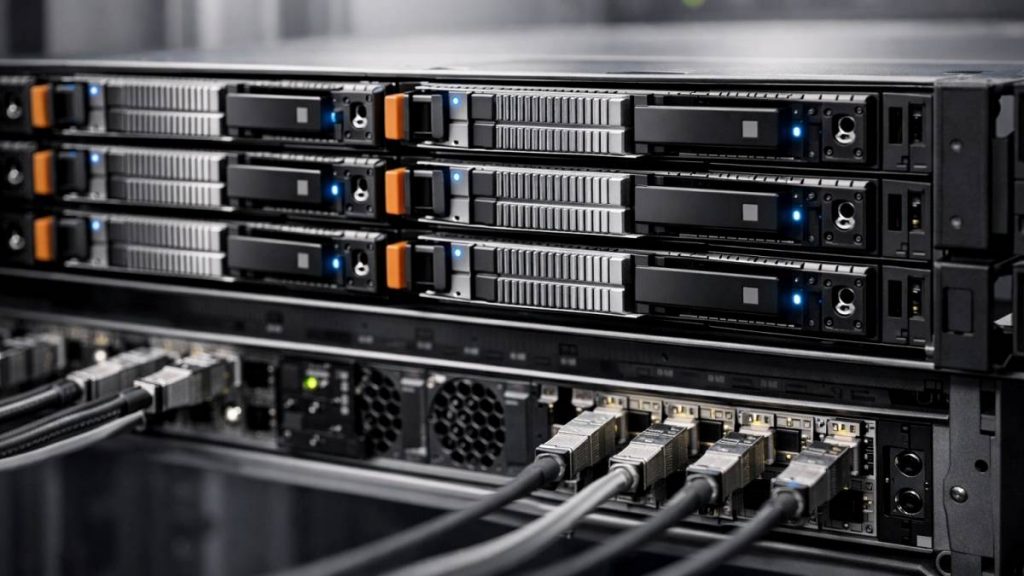
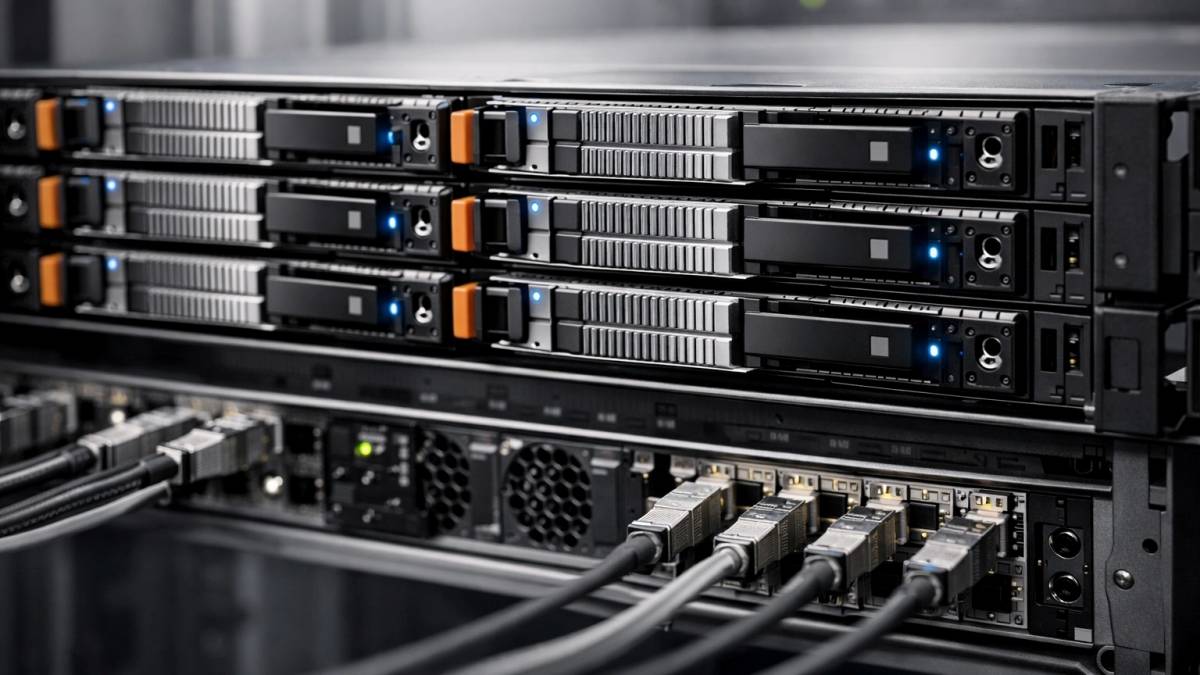
At Datacate, we specialize in Bare Metal performance. When you use colocation or dedicated bare metal servers, you aren’t sharing a storage array with a thousand strangers. You have Direct-Attached Storage (DAS).
Using NVMe drives directly connected to the server’s PCIe bus eliminates the network tax and the noisy neighbor problem. Instead of 3ms or 10ms latencies, you’re looking at microseconds. This allows your hardware to actually perform at its rated speed.
Why Datacate is Different
We don’t just provide space in a rack; we provide a high-performance ecosystem.
- Owned and Operated: We own our facility, meaning we control every inch of the path from the power grid to your drive bay.
- Fast Response: When performance issues arise, you don’t want a chatbot. You want a human tech who can be at your rack in minutes.
- Compliance Ready: Our facilities are SOC 2 Type II and HIPAA compliant, ensuring that your high-performance storage is also highly secure.
Compliance and the Physical Layer
Latency isn’t the only thing that gets lost in the public cloud; control does, too. For industries like healthcare and finance, knowing exactly where your data sits is a regulatory requirement.
In a multi-tenant cloud, your data is “somewhere” on a distributed cluster. In a colocation environment at Datacate, your data is stored on a specific physical disk in a specific rack, protected by biometric access and 24/7 surveillance. This physical certainty makes SOC 2 and HIPAA audits significantly cleaner and easier to manage.
Conclusion: Stop Guessing, Start Measuring
If your infrastructure feels sluggish, stop looking at your CPU usage and start looking at your disk wait times. Storage latency is the silent killer of modern application performance, but it isn’t an unbeatable foe.
By moving away from the “one-size-fits-all” approach of public cloud and embracing dedicated, bare-metal infrastructure, you can eliminate the physical bottlenecks that hold your business back.
Are you ready to see what your applications can actually do when they aren’t waiting on a “noisy neighbor”? Let’s talk about how Datacate’s owned-and-operated data centers can give you the performance, security, and reliability your business deserves.