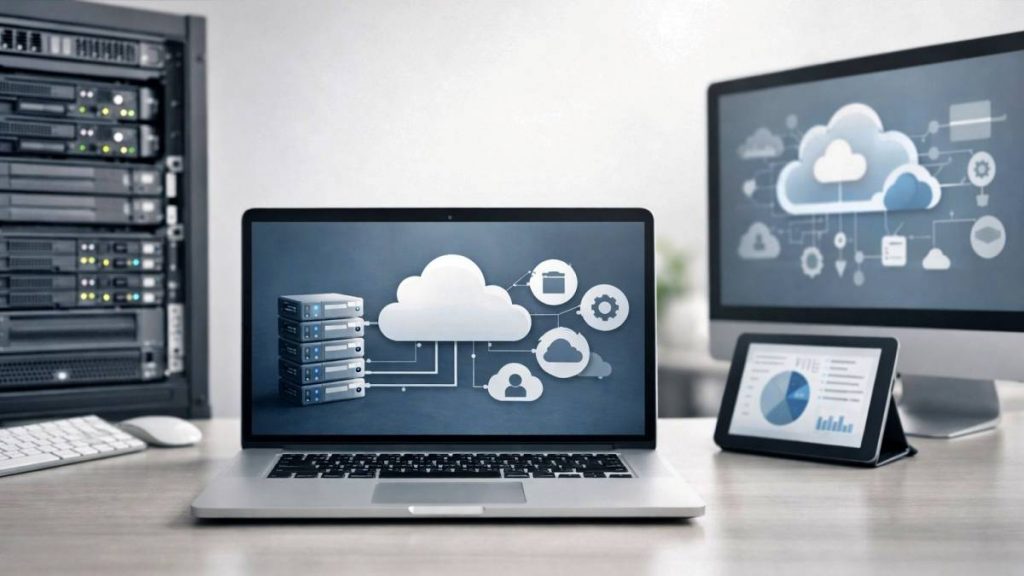
For the last decade, the IT industry has been shouting a single, monolithic message from the rooftops: “Cloud or Bust.”
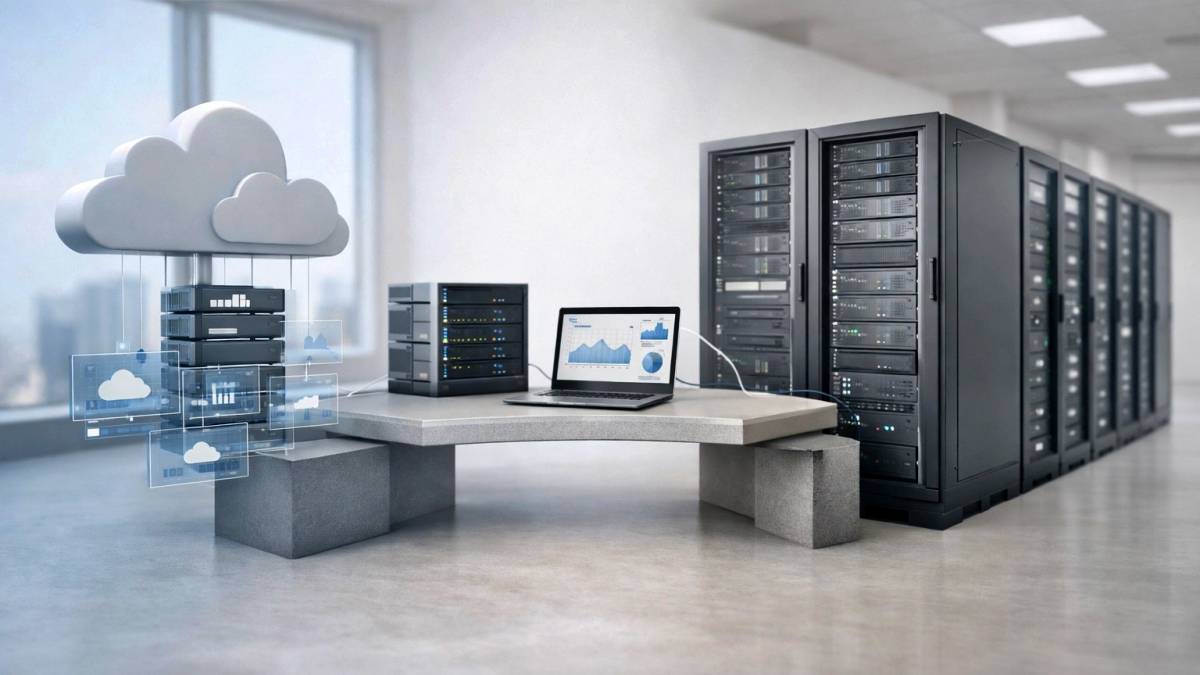
If you listen to the marketing hype, you’re either a forward-thinking, “cloud-native” visionary, or you’re a dinosaur clinging to dusty hardware in a basement. This binary choice has forced many business leaders into a corner. They feel they must choose between the infinite scalability of the public cloud (AWS, Azure, Google) or the control and fixed costs of traditional colocation.
But here’s the secret that the big cloud providers don’t want you to know: It’s not a zero-sum game.
The most successful, cost-efficient, and resilient companies aren’t choosing one or the other. They are finding the “Goldilocks Zone”: the perfect temperature of IT infrastructure known as the Hybrid Cloud. By combining the rock-solid reliability of colocated hardware with the elastic “burstability” of the public cloud, they get a solution that is just right.
The Myth of the All-In Strategy
The “All-In” cloud strategy is often driven by the promise of lower costs and zero maintenance. However, as many enterprises have discovered the hard way, the public cloud can be incredibly expensive when it’s used for everything.
When you move massive, steady-state workloads: the data and applications that run 24/7/365 without much change: to the public cloud, you aren’t just paying for the service. You’re paying a premium for flexibility you aren’t even using. It’s like renting a luxury hotel room for a year when you could have just rented a simple apartment. You’re paying for the nightly turndown service and the minibar, even if all you need is a place to sleep.
Conversely, staying 100% on-premises or in a traditional colo without any cloud integration can leave you “brittle.” If your business experiences a sudden surge in traffic, say, a viral marketing moment or a seasonal spike, you might not have the hardware on hand to handle the load.
Steady-State: Why Colo is Your Bedrock
Let’s talk about “Steady-State” workloads. These are the workhorses of your business: your core databases, your primary file storage, and your heavy-duty applications that stay consistent.
For these workloads, colocation is almost always the superior choice for three main reasons:
- Cost Predictability: In a datacenter like Datacate’s, your costs are predictable. You know exactly what you’re paying for space, power, and cooling. You don’t get hit with “egress fees” just for looking at your own data.
- Hardware Optimization: When you own the hardware, you can tune it specifically for your application. In the public cloud, you are often limited to generic “instances” that might not be the perfect fit for your specific database requirements.
- Data Sovereignty and Retention: For many industries, knowing exactly where your data sits is a legal requirement. Having your own servers in a secure facility makes data retention policies much easier to manage and audit.
The Cloud’s True Purpose: The “Bursty” Stuff
If colo is the bedrock, the public cloud is the “super-spanner” in your toolkit. The cloud shines when things are unpredictable.
Modern IT strategies utilize “Cloud Bursting.” This is the practice of running your primary application on your private hardware in a datacenter, but having a configuration that automatically “bursts” into the public cloud when demand exceeds your capacity.
- Development and Testing: Why buy a server for a project that will only last two weeks? Spin it up in the cloud, test it, and tear it down.
- Disaster Recovery: The cloud is a fantastic place to keep a “cold” or “warm” backup of your environment, ready to be ignited if a catastrophic event occurs.
- Geographic Reach: If you suddenly need to serve customers in a region where you don’t have a physical presence, the public cloud can get you there in minutes.
Performance, Latency, and the Edge
One of the biggest arguments for the Hybrid Goldilocks Zone is performance. As we move toward more real-time applications: AI processing, IoT, and high-frequency transactions, latency becomes the enemy.
Physics is a stubborn thing. No matter how fast the cloud is, the further your data has to travel, the slower the response. By keeping your core data in a strategically located datacenter like ours, you are engaging in “Edge Computing.” You are placing processing power closer to users or data sources.
When you integrate this with a hybrid model, you can use direct-connect services. These are private, high-speed “pipes” that link your colocated hardware directly to the AWS or Azure backbone. This bypasses the public internet entirely, giving you the security and speed of a local network with the reach of the global cloud. If you find that your connection to your remote tools is lagging, it might not be the cloud’s fault: it might be the architecture.
Control: Maintaining Ownership of Your Core
There is a growing movement in tech called “Cloud Repatriation.” It’s the trend of companies moving their core workloads out of the public cloud and back into colocation or on-prem environments. Why? Because they realized they lost control.
When your entire infrastructure is behind a proprietary cloud dashboard, you are at the mercy of that provider’s pricing changes, service outages, and policy shifts. By maintaining a hybrid approach, you keep the “keys to the kingdom.” Your core data and most critical IP stay on hardware you own and control. If a cloud provider raises prices by 30%, you have the leverage to move that portion of your workload elsewhere because your foundation is already secure.
Why Datacate is the Foundation for Your Goldilocks Zone
Building a hybrid environment sounds complicated, but it’s much easier when you partner with the right facility. At Datacate, we don’t just rent you a rack and walk away. We own and operate our facility, which gives us a unique perspective on the strategy behind modern IT.
We provide the “Goldilocks” foundation by offering:
- Carrier Neutrality: Connect to the provider you need to bridge the gap to the public cloud.
- High-Density Power: The ability to run the heavy-duty hardware that modern workloads demand.
- Hands-on Support: Unlike the “black box” of the public cloud, we have real people on-site who know your name and your rack.
In the modern era, IT isn’t about choosing between the old and the new. It’s about being wise enough to use every tool available. You don’t have to choose between the reliability of hardware and the flexibility of the cloud. You can have both. Whether you are dealing with software crashes or architecting a multi-state network, the goal is always the same: reliability. The hybrid cloud is the most reliable way to ensure your business stays online, stays fast, and stays profitable.
Ready to find your balance? Stop trying to force your business into an “All-In” box that doesn’t fit. Let’s find your Goldilocks Zone together. Reach out to the team at Datacate and let’s talk about building an infrastructure that’s “just right.”