It’s an inconvenient truth: that server closet down the hall, humming away behind a door nobody opens unless something breaks? It’s costing you way more than you think.
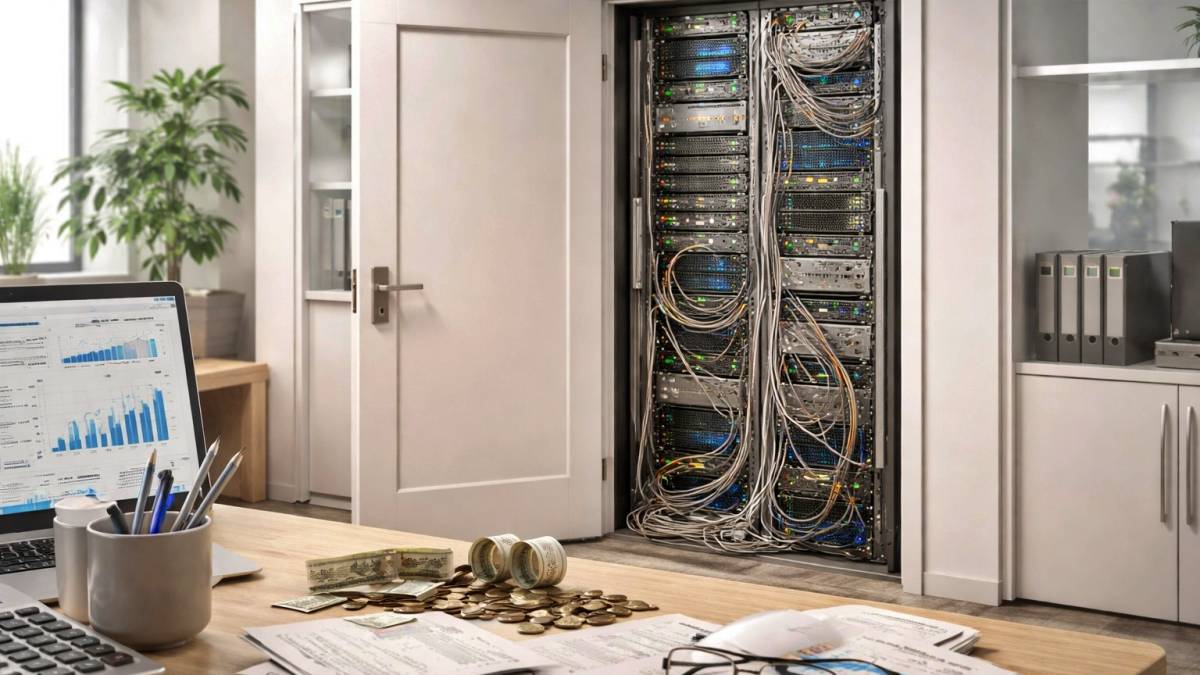
Most businesses treat in-house servers like they’re “free” infrastructure. The hardware’s already paid for. The closet was just sitting there anyway. And IT handles everything, so what’s the big deal?
The big deal is what accountants call “hidden costs”, and what we call the Server Closet Tax. It’s the slow, steady drain on your budget that never shows up as a single line item but adds up to thousands of dollars every year.
Let’s break down exactly where that money goes.
The Electricity Bill You’re Pretending Doesn’t Exist
Servers are hungry. A single mid-range rack server pulls somewhere between 500 and 1,000 watts. Run that 24/7/365, and you’re looking at 4,380 to 8,760 kilowatt-hours per year, per server.
At California’s average commercial electricity rate (which hovers around $0.22 per kWh as of early 2026), that’s roughly $960 to $1,930 per year just to keep one server powered on.
Got three servers? Five? A small storage array? The math gets uncomfortable fast.
And here’s the kicker: that’s just the power going into the servers. We haven’t even talked about getting the heat out yet.
Cooling: The Silent Budget Killer
Every watt of electricity your servers consume turns into heat. All of it. Physics doesn’t negotiate.
That heat has to go somewhere, which means your building’s HVAC system is working overtime to keep that closet from turning into a sauna. The general rule of thumb? For every watt of server power, you need another 0.5 to 1.0 watts of cooling. Some older buildings push even higher.
So if your servers are pulling 2,000 watts, your cooling system is burning an additional 1,000 to 2,000 watts just to compensate. That’s potentially doubling your electricity costs for that closet.
Oh, and most office HVAC systems weren’t designed for this. They’re built for people, not processors. Running them this hard accelerates wear and tear, which means more maintenance calls, more repairs, and eventually a costly replacement.
The UPS Reality Check
Power goes out. It happens. And when it does, your servers need to stay online long enough to shut down gracefully, or ideally, keep running until power returns.
That’s where your Uninterruptible Power Supply comes in. Except most businesses either:
- Don’t have one (yikes), or
- Have one that’s undersized (also yikes), or
- Have one with batteries that haven’t been replaced in years (the most common yikes)
A decent UPS for a small server setup runs $1,500 to $5,000 upfront. Batteries need replacement every 3-5 years, adding another $300 to $1,000 each cycle. And if you want enough runtime to actually matter during an extended outage, you’re looking at even bigger units with even bigger price tags.
Meanwhile, most businesses set it and forget it: right up until the moment the power blinks and they discover their “backup” died two years ago.
Space Isn’t Free
That closet has value. Maybe not obvious value, but value nonetheless.
What else could you do with 50 to 100 square feet of climate-controlled office space? Another workstation? A small meeting room? Storage that doesn’t require earplugs?
Commercial real estate in the Sacramento region runs anywhere from $1.50 to $3.00+ per square foot per month, depending on location and building class. A modest server closet could easily represent $1,000 to $3,000 per year in opportunity cost.
Plus, that space needs to be secured. Locked doors, limited access, maybe even a camera. Physical security isn’t glamorous, but it’s necessary, and it’s another line item that rarely gets attributed back to the servers that require it.
The Noise Tax
Let’s talk about something that doesn’t show up on any invoice: the constant, droning hum of server fans.
Anyone who’s worked near a server closet knows the sound. It’s not loud enough to require hearing protection, but it’s loud enough to be annoying. Loud enough to make phone calls difficult. Loud enough to slowly drive your team a little crazy.
Productivity is hard to measure, but comfort isn’t. And servers in the office are a comfort killer.
Some businesses try to solve this with soundproofing, which is another expense. Others just live with it. Neither option is great.
The IT Time Sink
Your IT team (or your one IT person, or your “I guess I’m IT now” office manager) has better things to do than babysit hardware.
But servers in a closet demand attention. Firmware updates. Drive replacements. Fan failures. Mysterious beeping at 2 AM that triggers a building alarm. The time adds up, and it’s almost always unplanned.
Every hour spent troubleshooting an aging server is an hour not spent on projects that actually move the business forward. That’s a hidden cost that impacts your productivity, morale, and, eventually, your bottom line.
Let’s Do the Math
Here’s a realistic annual breakdown for a small in-house server setup (let’s say three servers and a basic network switch):
That’s the Server Closet Tax. And most businesses have no idea they’re paying it.
What Colocation Actually Costs
Here’s where it gets interesting.
A basic colocation setup: a quarter rack in a professional data center with redundant power, cooling, and physical security, typically runs between $300 and $600 per month in the Sacramento region. That’s $3,600 to $7,200 per year.
For that price, you get:
- Redundant, utility-grade power with generator backup
- Precision cooling explicitly designed for servers
- 24/7 physical security with biometric access and cameras
- Multiple internet carriers competing for your business, or available in a ready-to-use redundant blend
- Remote hands support when something needs a physical touch
- Compliance certifications (SOC 2, HIPAA) that you can leverage for your own audits
Compare that to the $7,000 to $18,000+ you’re spending on your closet, and the math starts to look very different.
The Bottom Line
The server closet isn’t free. It never was.
It’s just that the costs are spread across your electric bill, HVAC maintenance, your IT team’s time, and a dozen other areas that are easy to overlook. Add them up, and you’re often paying more for a worse experience than you’d get from a professional facility.
Colocation isn’t right for every business. But if you’ve been running servers in-house because you assumed it was the cheaper option, it’s worth doing the real math.
You might be surprised by what you find.
Curious what colocation would actually cost for your setup? We’re happy to walk through the numbers with you: no pressure, no pitch. Just math. Reach out to the Datacate team and let’s talk.